There's pee on your floor. Bite marks on your hands. You've slept maybe four hours total in the last two days. And somewhere around 2 am last night, while your puppy screamed in his crate like you were murdering him, you thought: What have I done?
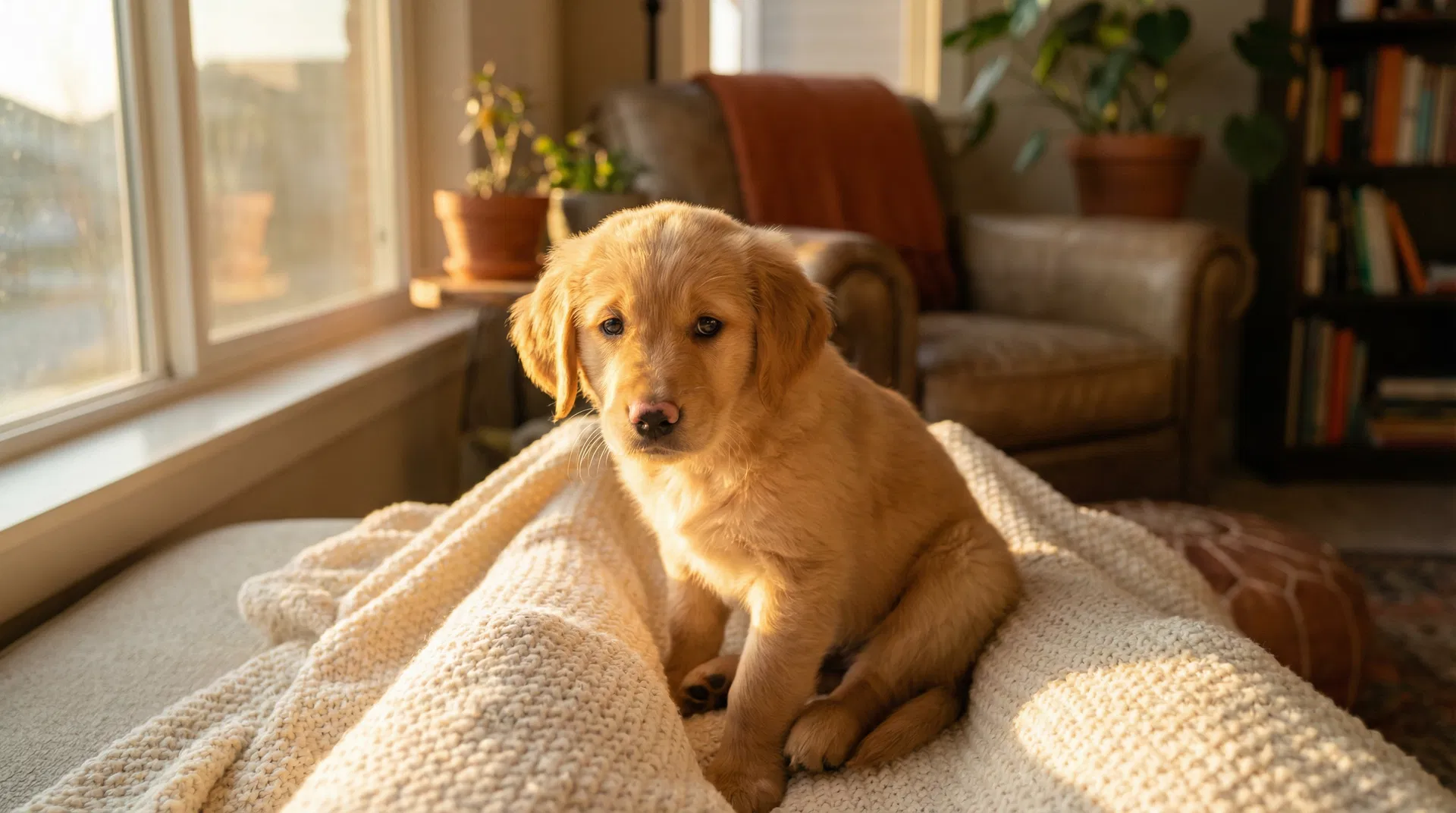
You pictured this differently. The fluffy Instagram version. The golden retriever puppy curled in your lap, gazing up at you adoringly. Not this chaos. Not the constant vigilance, the accidents, the crying that makes your chest hurt because you can't fix it.
Here's what I need you to hear: you're not failing. This is just what the first week home with a golden retriever puppy looks like.
The people with the Instagram puppies? They went through this, too. They just didn't post it. Nobody does. So you're standing in your kitchen at 4 a.m., thinking you're uniquely terrible at this, when actually, you're experiencing exactly what almost everyone experiences. They just never told you.
I'm going to tell you.
The First Night
Yesterday, your puppy slept in a pile of warm bodies. His mother, his siblings, the only family he's ever known. Tonight, he's alone in a crate in a dark room, and he has no idea where everyone went.
The crying you're hearing isn't manipulation. It's not him "testing you" or "being dramatic." It's a contact call a baby animal trying to find his pack. And right now, his pack is gone.
Put the crate next to your bed. Not in another room. Not downstairs. Right next to you, where he can hear you breathe and smell that you're there. This one decision will cut the crying in half. Your presence is the closest thing to safety he has right now. You're not spoiling him. You're being his pack until he learns that this new place is home.
Before bed, wear him out. Not a walk (he's too young for that), but play — tug, fetch down the hallway, letting him chase you around the living room. You want him tired enough that sleep feels like relief. Take him outside to potty right before you crate him. Skip the water for the last half hour so his tiny bladder has a fighting chance.
When he cries, wait. Count to sixty in your head. If it's been less than three hours since he last went out, he probably doesn't need to potty. He just doesn't want to be alone. Let your hand hang off the bed so he can smell you. Some people swear by those stuffed animals with heartbeats and heat packs inside. If your breeder gave you a blanket that smells like his mother or siblings, put it in the crate.
If the crying escalates, if it goes from whimpering to frantic, take him out for a quick, boring potty trip. No play. No talking. Carry him outside, wait, praise quietly if he goes, carry him back, crate him again. The goal is to meet the need without making 2 am into party time.
The first night is almost always the worst. Most puppies settle by night three or four. Some take a full week. If yours is still crying after seven days, you haven't broken anything. Some pups are just harder. Keep going.
One thing that helps: set an alarm for three or four hours in and take him out before he wakes up crying. It sounds counterintuitive — why wake yourself up? But it teaches him two things. First, that you'll come back. Second, that the crate isn't a place he has to scream his way out of. You're building trust. It matters more than sleep right now.
The Crate Isn't the Problem
Your puppy doesn't hate the crate. He hates being alone in the crate. There's a difference, and it changes everything.
Golden Retrievers were bred for partnership. For 150 years, their entire job has been to stay close to a human, watch that human, anticipate what that human needs. Solitude isn't in their wiring. When you close that crate door and walk away, you're asking him to do something that feels deeply wrong to him.
He'll learn. But you have to teach him that the crate is good before you start using it to contain him.
Feed every meal inside the crate with the door open. Toss treats in randomly throughout the day. When he falls asleep on the floor, scoop him up and set him inside still, with the door open so he wakes up thinking, Huh, this is where naps happen. You're building a history: crate means food, crate means rest, crate means good things.
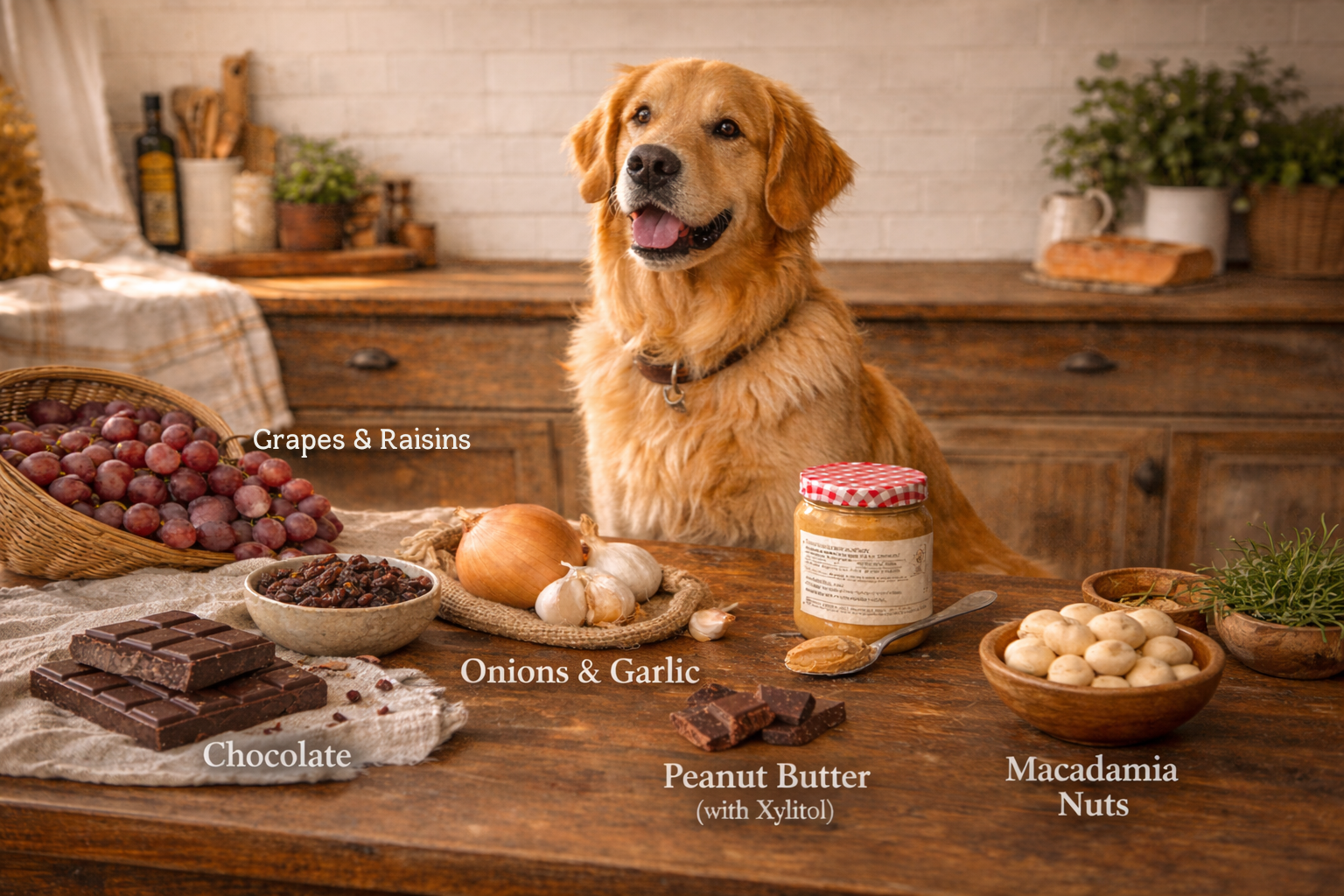
When you start closing the door, do it while he's distracted. A frozen Kong stuffed with peanut butter. A bully stick. Something that takes time and focus. Stay in the room at first. Then in the next room. Then step outside for thirty seconds. Build it in tiny increments, always returning before he panics. You're teaching him that a closed door doesn't mean abandoned.
Never use the crate as punishment. And when you let him out, keep it boring — no big celebrations. You want entering and exiting the crate to feel like nothing. Just a normal part of life, not a dramatic event.
If he fights the crate hard (I mean really hard — screaming for hours, hurting himself trying to escape), that's not normal adjustment. That's panic, and you need to slow way down or call a trainer. But most Golden puppies? They protest for a few days and then accept it. Consistency wins. It just doesn't feel like winning while you're in it.
Accidents Are Not Failures
He's going to pee on your floor. Probably today. Probably multiple times this week.
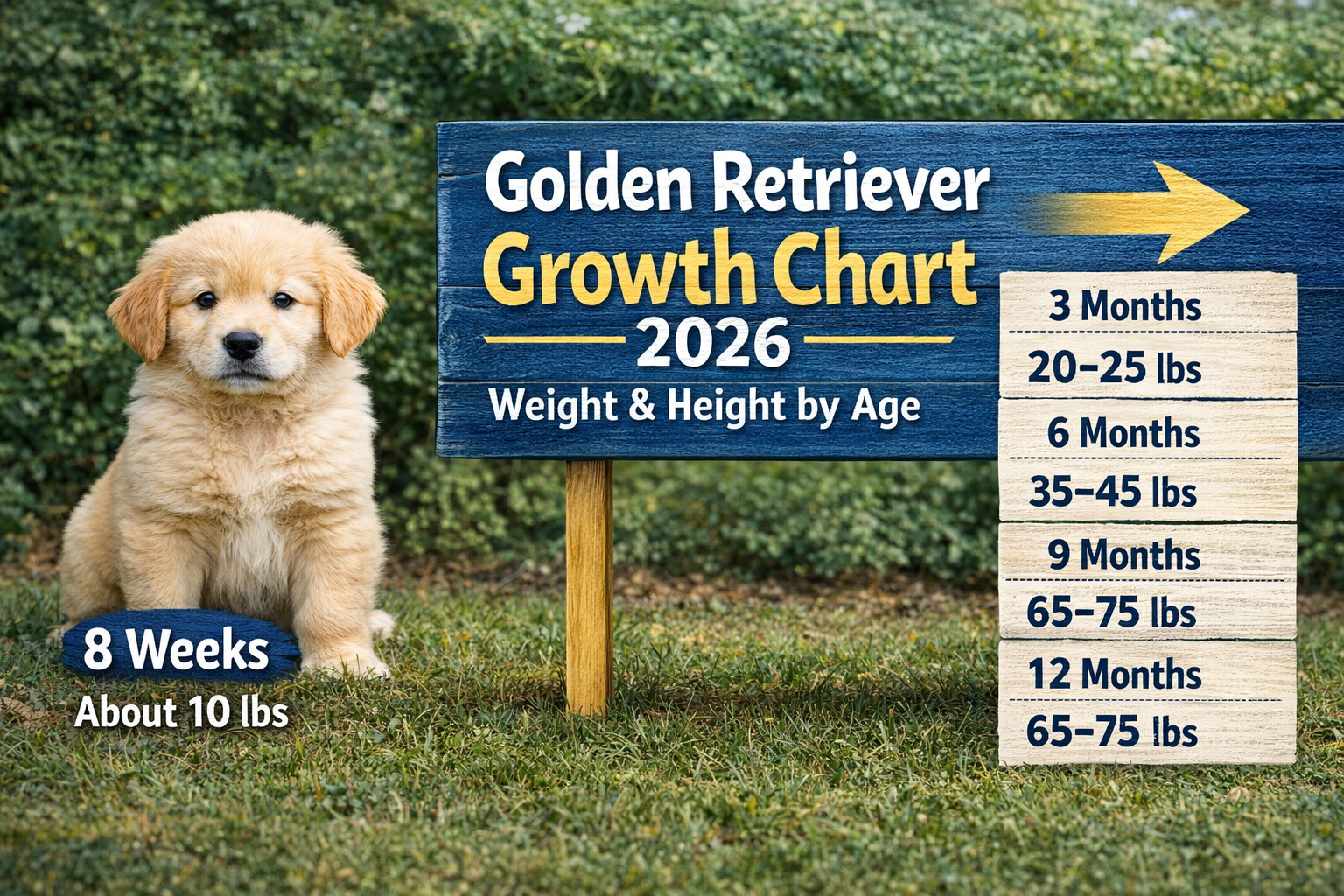
This isn't a training failure. It's biology. At eight weeks, your golden retriever puppy has almost no bladder control. He needs to go out after every nap, every meal, every play session, and roughly every 30 to 45 minutes when he's awake. Miss that window by five minutes, and he won't hold it. He can't hold it.
The strategy isn't to train him not to go inside. It's to get him outside so often that he never has the chance. Carry him, don't let him walk, because his little legs give him too much time to squat in the hallway — and take him to the same spot every time. Wait. When he goes, act like he just did something miraculous. "Good boy" in that ridiculous high voice you swore you'd never use. He needs to know that outside equals praise. That's the whole lesson.
When accidents happen, don't punish. Don't yell, don't rub his nose in it, don't swat him with a newspaper. He has no idea what he did wrong. He just knows you're suddenly angry, and now he's scared of you. That's not a lesson. That's damage.
Clean it up with an enzymatic cleaner — the kind that actually breaks down the urine instead of just covering the smell. If he can still smell it, he'll go back to that spot. Regular cleaners don't cut it. This matters.
If you catch him mid-squat, interrupt with "outside!" and scoop him up. If he finishes outside, praise him. If he finishes in your arms on the way out... well, that's week one. Welcome.
Pay attention to when accidents happen. Most puppies have patterns always 20 minutes after eating, or right after getting excited during play. Once you see the pattern, you can get ahead of it. Proactive beats reactive every time.
By the third week, you'll see real progress. By four to six months, you'll have a house-trained dog. But right now? Expect the accidents. Plan for them. Every successful outside trip is laying the foundation.
The "Did I Make a Mistake?" Feeling
Somewhere around day three, it hits.
The excitement is gone. The exhaustion isn't. And suddenly you're looking at this puppy — this creature you waited months for, planned for, obsessed over — and thinking: I don't know if I can do this.
Maybe you feel trapped. Maybe you resent him. Maybe you've caught yourself googling "return puppy to breeder" at 2am and then felt so guilty you couldn't sleep.
This feeling is so common it has a name: the puppy blues. And it happens to far more people than you'd think. The majority of new puppy owners experience some version of it — anxiety, regret, depression, the whole spectrum. You're not uniquely broken. You're not bad at this. You're just in the hard part.
The puppy blues peak in weeks two through four, then fade as the puppy matures and your routine stabilizes. What helps: structure. A predictable schedule reduces the chaos that feeds the overwhelm. What also helps: saying it out loud. Tell your partner, your friends, other dog people. You'll be shocked how many of them say, "Oh god, yes. The first few weeks were brutal."
There's a concept called the Rule of Threes. In three days, your puppy is still scared and confused. In three weeks, he's starting to understand the routine. In three months, he feels like he's always been yours.
If you can get through the first three weeks, you'll almost certainly be glad you did. And here's something no one tells you: the harder the beginning, the more you'll forget it. A year from now, you'll look back on this week and barely remember how bad it felt. The frustration fades. The love doesn't.
This Is What Week One Is Actually For
I know you wanted a training guide. A checklist. "Do these five things and your puppy will be perfect by Friday."
That's not what week one is for.
Week one is for one thing: helping your golden retriever puppy feel safe enough to start learning. That's it. A puppy who feels safe will eventually love his crate. A puppy who feels safe will bond with you so deeply it'll break your heart a little. A puppy who feels safe will become the dog you imagined when you first decided a Golden Retriever was the one.
But safety takes time. It can't be rushed. So, for now, just for now, lower your expectations. Celebrate the tiny wins. Forgive the accidents, the noise, the chaos. You're not behind. You're just at the beginning.
In a few weeks, you'll barely remember how hard this was. In a few months, you'll have a Golden Retriever sprawled across your lap, sighing that contented sigh they do, looking at you like you're the only person in the world.
And you'll think: Oh. This is why.
The first week is survival. Everything after that is falling in love.
You're building something right now, even if it doesn't feel like it. Jazzi Paws is for the people in the trenches — the ones who show up at 4am, the ones who know the bond is earned, not given. Shop the Golden Retriever Collection →
If you're navigating the emotional rollercoaster of that first week, you're not alone — and it does get easier. Once you've survived the sleep deprivation and the crate training standoffs, you might find yourself dealing with a whole new challenge: Golden Retriever separation anxiety. It's worth reading about before it catches you off guard. And when you're ready to understand what your dog is actually trying to communicate, these five signs your Golden is trying to tell you something will change how you see every interaction. For the deeper science behind why this bond hits so hard from day one, the science behind the Golden Retriever bond is worth a read too.