You thought you were doing enough. Two walks a day, fifteen or twenty minutes each. He seemed happy — tail wagging, sniffing everything, glad to be outside. You figured that was the job done.
But lately he's been different. Pacing. Whining at nothing. Chewing things he knows not to chew. And when you finally sit down at night, he's standing there, staring at you, like he's waiting for something you're not giving him.
You're not imagining it. He is waiting. And he's been waiting for a while.
Golden Retrievers were bred to work all day in the Scottish Highlands, retrieving shot waterfowl through rough terrain and cold water. That drive didn't disappear because he lives in a house with climate control. A fifteen-minute walk around the block isn't exercise for a Golden. It's a bathroom break. And when the gap between what he needs and what he's getting grows wide enough, it starts showing up in his behavior, his weight, and eventually, his joints.
Why This Matters More Than Most Owners Realize
Nearly 60% of dogs in the United States are overweight or obese. Goldens are particularly susceptible because they're food-motivated, built for activity, and often owned by people who underestimate what "active breed" actually means.
The consequences of under-exercise accumulate quietly. Weight creeps up. Muscle tone fades. Joints lose support. And behavior problems emerge: pacing, whining, destruction, hyperactivity that makes people say "he's just a crazy dog" — when really he's an under-stimulated dog whose needs aren't being met.
There's another mistake just as common: exercising a young Golden too hard, too soon. Getting it right isn't just about doing enough. It's about doing the right amount for where your dog is in life.
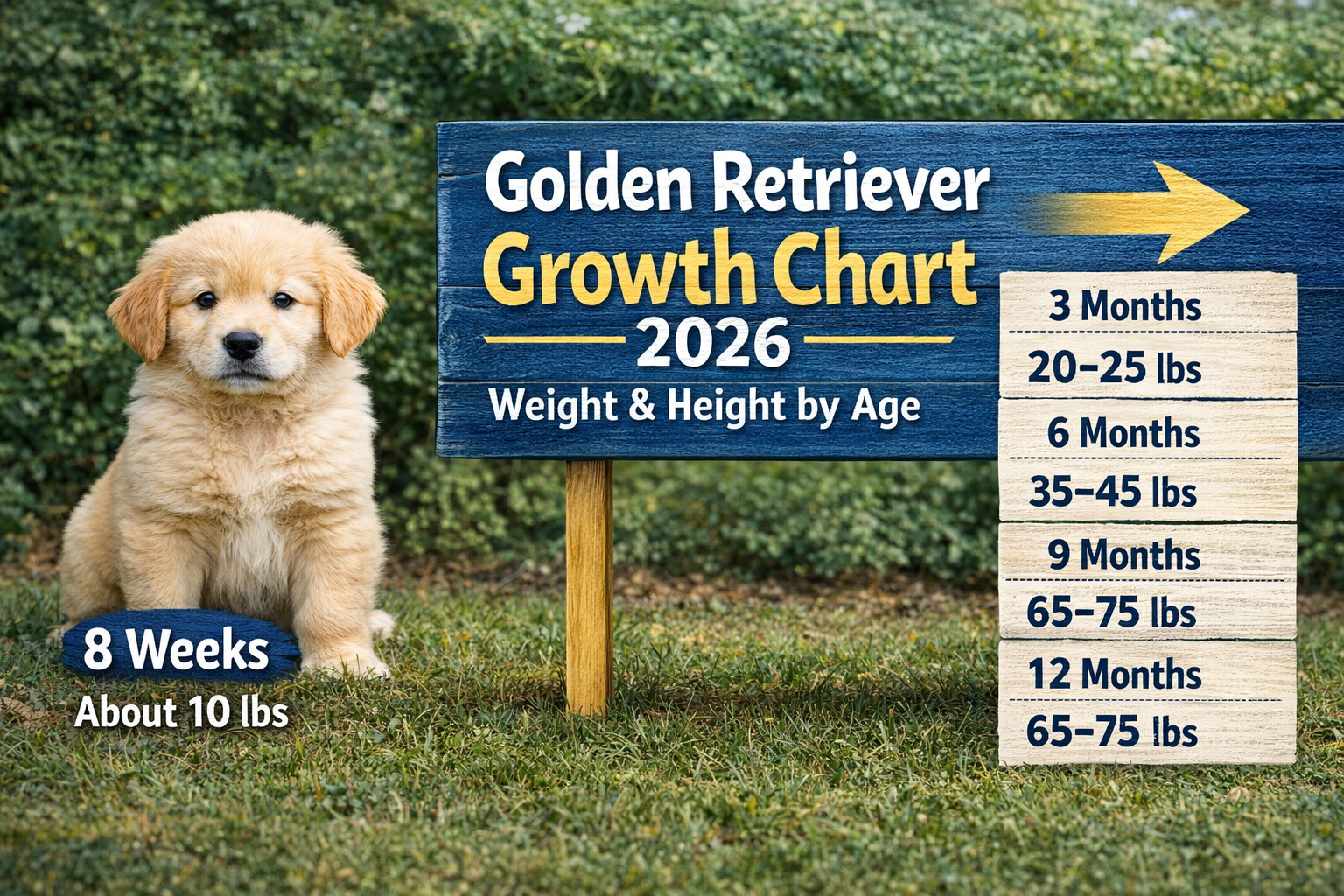
Golden Retriever Puppy Exercise (8 Weeks to 12 Months)
Your Golden's growth plates — areas of developing cartilage that harden into bone — don't fully close until 12 to 18 months, with some dogs taking up to 24 months to reach full skeletal maturity. During this period, joints are vulnerable to repetitive stress.
You've probably heard the "5-minute rule": five minutes of exercise per month of age, twice daily. A four-month-old gets two 20-minute sessions. This guideline is widely repeated by breeders and veterinarians.
Here's what the research says: there's no hard evidence proving this specific formula prevents joint disease. Studies suggest genetics and maintaining a healthy weight are bigger factors in whether a Golden develops hip or elbow dysplasia. That doesn't mean the caution is pointless — what research does support is avoiding high-impact, repetitive activity on developing joints: forced running on hard surfaces, endless fetch on concrete, repetitive jumping.
The practical approach: let puppies self-regulate during free play. Short leash walks on soft surfaces are fine. Mental enrichment — puzzle feeders, basic training — tires puppies without joint stress. What you want to avoid is the forced march, making a puppy keep pace on a long run when they'd rather stop. Watch for fatigue. If your Golden lies down mid-walk, that's not stubbornness. That's exhaustion.
Adolescent Golden Retrievers (12 to 18 Months)
This is the transition period. Growth plates are closing but your Golden isn't fully mature. Energy levels are at their absolute peak. Your dog wants to go, go, go. You can finally increase duration and intensity — just gradually.
Swimming becomes your best friend during this stage. It's a full-body workout with zero joint impact, and Goldens are natural swimmers — the breed was literally developed to work in water. Most take to it instinctively. If you have access to safe swimming, prioritize it. Twenty minutes in the water tires a Golden as effectively as an hour of running, without the repetitive loading on joints that aren't quite finished developing.
This is also when mental exercise becomes increasingly important. Your adolescent has the physical capacity for longer sessions, but they also need their brain worked. A 20-minute training session can tire a Golden as much as an hour of physical exercise — and it builds the skills that make the next decade easier.
Adult Golden Retriever Exercise Needs (18 Months to 7 Years)
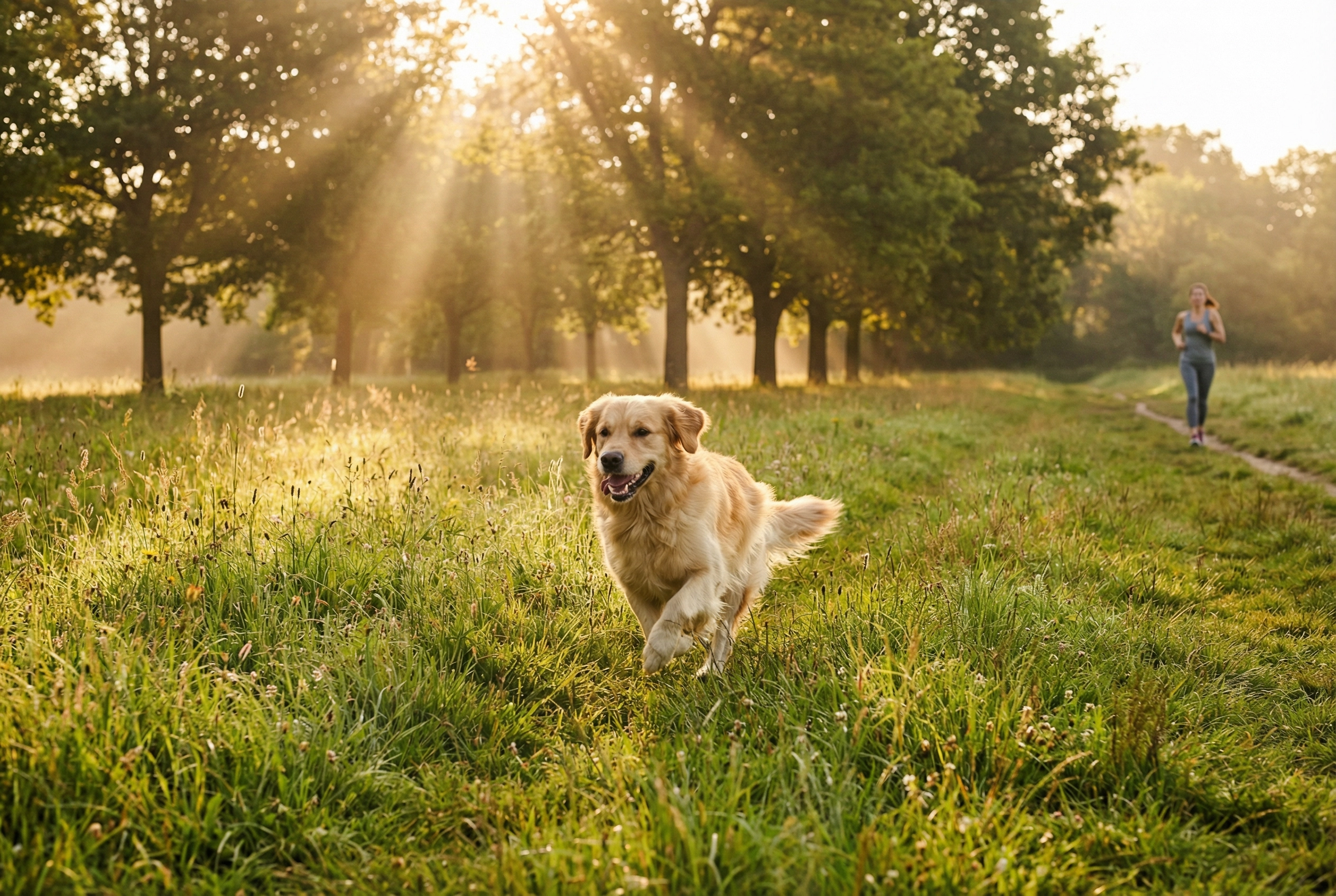
Here's the number most owners need: one to two hours of vigorous exercise per day. Not walking. Vigorous. Elevated heart rate, panting, actually working.
What counts as vigorous? Swimming, fetch on grass or soft surfaces, trail hiking on varied terrain, off-leash running in safe areas when your recall is reliable. These activities engage your Golden's natural drives: retrieving, swimming, exploring. A slow walk around the neighborhood checks the mental enrichment box but doesn't come close to meeting physical needs.
A working schedule: morning session of 30 to 45 minutes (walk plus active play or training), evening session of 30 to 45 minutes, plus mental enrichment throughout the day. That's baseline. High-energy dogs may need more.
Signs you're not hitting the mark: destructive behavior, excessive barking, hyperactivity indoors, inability to settle, weight gain. A well-exercised Golden is calm indoors. They settle, they nap, they don't pace or destroy furniture. If your dog can't relax, the first question is whether they're getting enough outlet.
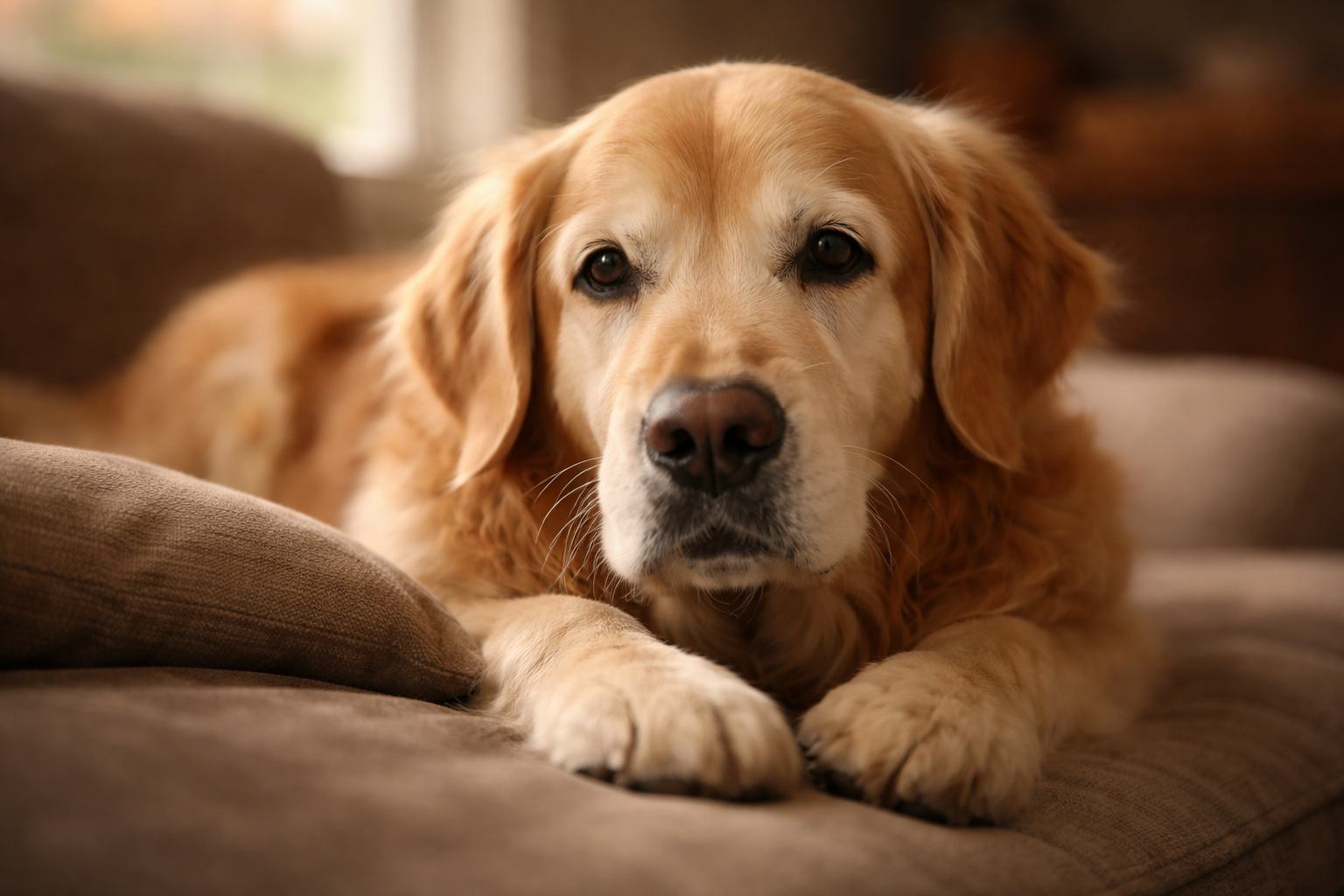
Senior Golden Retriever Exercise (7+ Years)
Here's the paradox: stopping exercise is as harmful as overdoing it.
As dogs age, they lose muscle mass. Muscle supports and protects joints. The senior Golden who stops exercising because "he's slowing down" actually accelerates joint deterioration — because the muscle protecting those joints atrophies.
The key isn't reducing frequency. It's adjusting intensity. Shorter sessions, lower impact, same regularity. A senior who used to run for an hour might now walk for 30 minutes, twice daily. Swimming remains the gold standard.
The "decompression walk" is particularly valuable for seniors: a slow, sniff-led walk where your dog sets the pace and direction. You're not covering distance. You're letting them experience the environment at their own speed, stopping to investigate every scent. These walks are mentally satisfying without physical strain.
Watch for subtle signs of pain: lagging behind when they used to lead, stiffness after resting, reluctance to go out, slight gait changes. Your senior won't tell you something hurts. They'll push through because they want to please you. These signals mean modify — not stop.
What Actually Counts as Exercise
| Activity | Intensity | Notes |
|---|---|---|
| Leash walk at human pace | Low | Good for mental enrichment, not sufficient as primary exercise for healthy adults |
| Fetch (on grass) | High | Excellent for cardio. Play on grass to reduce joint impact |
| Swimming | High | The gold standard. Full-body workout, zero joint impact. 20 minutes = 1 hour on land |
| Trail hiking | High | Variable terrain engages different muscle groups and builds core strength |
| Dog parks | Variable | Social enrichment, not reliable exercise — depends entirely on what happens there |
| Mental exercise (training, nose work) | Low–Medium | Underrated. Tires dogs without physical strain. Essential for puppies, seniors, and recovering dogs |
Exercise and Joint Health
Goldens are predisposed to hip dysplasia, elbow dysplasia, and CCL disease. This isn't a reason to avoid exercise. It's a reason to exercise thoughtfully.
Appropriate exercise builds muscle that supports joints. Strong muscles stabilize the joint capsule and distribute load evenly. A well-muscled Golden is better protected against joint disease than a sedentary one — even accounting for genetic predisposition. Inappropriate exercise accelerates damage: wrong type, wrong intensity, wrong surface. The goal is enough activity to build muscle, not so much that you wear joints down faster than they recover.
Modify after surgery, after an arthritis diagnosis, or after any limping that doesn't resolve in 24 hours. Modification means adjusting, not stopping.
How to Know You're Getting It Right
Body condition: You should feel ribs easily without pressing hard, but not see them prominently. Visible waist from above, tucked abdomen from the side.
Energy levels: A well-exercised Golden is calm indoors, engaged outdoors. They settle and nap without pacing or destruction.
Sleep: Adults sleep 12 to 14 hours daily. Puppies and seniors sleep more.
Behavior: Destructive behavior and hyperactivity are symptoms of under-exercise, not personality traits.
He's not pacing because he's difficult. He's pacing because he's built for a job he's never been given.
The right amount of exercise: one to two hours of meaningful activity for adults, gradually increasing for adolescents, protected joints for puppies, adjusted intensity for seniors. Start where you are. Build gradually. Add swimming if you have access. Incorporate training alongside physical activity. Watch body condition and behavior. Adjust as you go.
The payoff isn't just a calmer dog. It's a healthier dog with stronger muscles supporting vulnerable joints — a dog who lives longer and better because you finally gave him the outlet his body was designed for.
The exercise protocols for senior Goldens are covered in detail in Chapter 5 of the Senior Golden Retriever Guide, including decompression walk technique, activity adaptation by mobility level, and signs of joint pain most owners miss.
Disclaimer: This content is for educational purposes only and is not a substitute for veterinary care. Always consult your veterinarian for health concerns or before starting a new exercise program.