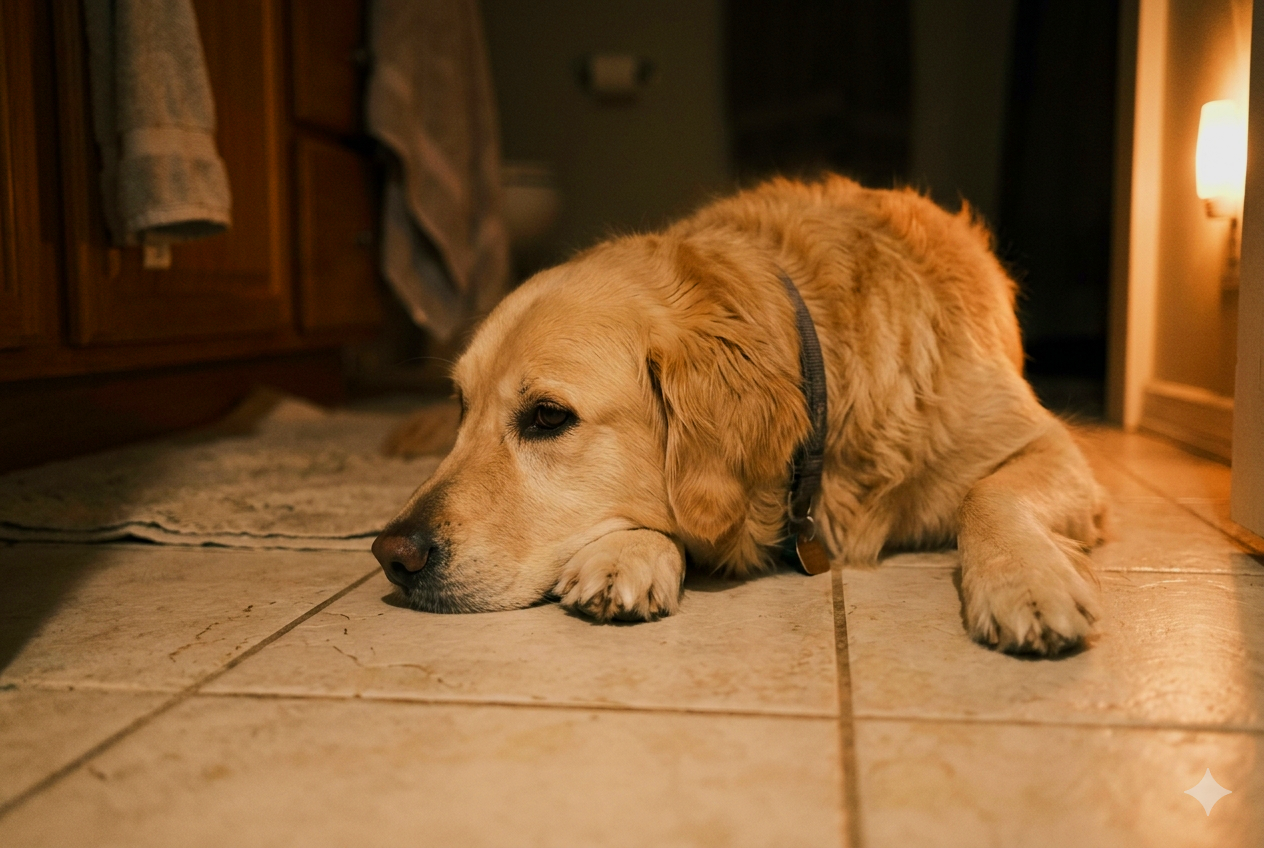
Here's what's happening on the bathroom tile at 2 a.m.
She's licking her paws again. That wet, rhythmic sound between the pads. Chewing the fur off her front leg. Scratching at ears you cleaned yesterday. Twenty minutes. An hour. Then a quiet stretch, then she's back at it.
You've tried the oatmeal shampoo. The grain-free kibble. The fish oil. A round of Benadryl. Another round. You changed her bedding. You wiped her paws after every walk. You spent six hundred dollars at the vet who sent you home with a medicated shampoo and a prescription bag of food. Three weeks later she's still on the bathroom tile.
The reason is simple, and once you see it, everything that's been failing you starts to make sense.
"Itchy Golden" isn't one problem. It's four. Only one of them is yours, and each one needs a completely different fix.
The shampoo that solves one does nothing for the others. The food change that fixes one is useless for the rest. The antibiotic that clears the infection doesn't stop the next one from coming back. This is why owners burn through a year and thousands of dollars before anyone stops and asks the right question.
This is the article that stops the guessing.
Why Goldens Are Built for This
Itchy Goldens aren't a personality trait. They're a breed trait.
The heritability of atopic dermatitis in this breed measures 0.47 in the landmark Shaw study, which means close to half the risk comes straight from the parents. Breed two allergic Goldens and roughly 65% of the puppies show up itchy. It's baked into the DNA of the breed before the dog ever walks in your door.
Then the Golden-specific anatomy stacks on top. The double coat traps pollen, grass, and dust against the skin like a sponge. The floppy ears stay warm and moist and grow yeast and bacteria the moment the skin barrier slips. And the hormonal layer underneath it all: one in four Goldens develops hypothyroidism over a lifetime, according to the Golden Retriever Club of America's health survey. That's the highest rate of any serious condition in the breed. Higher than hip dysplasia. Higher than cancer as a single-diagnosis rate at any given age.
None of this gets explained at the first vet visit. Most owners are handed a prescription shampoo and told to come back in three weeks. So let's fix that now.
The Four Causes. Find Your Dog.
Every itchy Golden falls into one or more of these. Read them looking for yours.
1. Environmental Allergies (Atopic Dermatitis)
Her immune system decides pollen, dust mites, mold, or grass are threats. It declares war on normal air. The itch focuses on paws, face, ears, armpits, and belly. She's the dog who licks the same front paw raw. She's the dog whose ears gunk up no matter what you put in them. Symptoms usually surface between age 1 and 3. Seasonal at first, then creeping toward year-round as dust mites replace pollen as the trigger.
This is the most common cause by a wide margin. If you had to bet on an itchy Golden, this is where the money goes.
2. Food Allergies
About 10 to 15% of allergic skin disease in dogs is food-driven. It gets blamed for a lot more than that on the internet. The symptoms look identical to environmental allergies, so you can't tell by looking. But here's what matters: food allergies in dogs are almost always reactions to proteins, not grains. Beef, chicken, dairy, eggs. The same proteins sitting in your grain-free bag.
3. Flea Allergy Dermatitis
Some dogs are allergic to flea saliva. For them, one bite triggers weeks of intense itching, focused on the tail base and lower back. The cruel part: you may never see a flea. She grooms it off before you notice. You check her coat, see nothing, and rule fleas out. Meanwhile, the one flea from three days ago is still driving her crazy. Golden coats are a flea-hiding paradise, and a single missed month of prevention can wreck a flea-allergic dog.
4. Hypothyroidism (the one almost nobody checks)
The thyroid gland runs metabolism. When it underperforms, the skin is often the first-place trouble shows. And in Goldens, it shows constantly, because the breed carries the genetic predisposition.
The signal that separates thyroid from allergies: hypothyroid dogs lose coat, but they don't desperately scratch at it. Allergies drive frantic, raw-skin scratching. Thyroid makes the coat look tired and fall out, often in symmetrical patches on both sides, with that classic thinning tail feather called "rat tail."
If the coat is going without the scratching, read that twice. A thyroid panel is a twenty-minute blood test. A daily pill of levothyroxine costs about $30 a month. Most dogs clear up within a couple of months of starting treatment. This is the single most common missed diagnosis in Goldens presenting with "skin problems."
Where She Itches Tells You Almost Everything
Before the next vet visit, match her pattern against this list. The pattern is diagnostic, and most owners have never been taught to read it.
What Her Scratch Pattern Means
Paws and between the toes: classic environmental allergies. She's reacting to what she walks on.
Armpits, belly, groin: same thing. Thin skin, maximum exposure.
Face rubbing on furniture or carpet: same immune reaction, now on her face.
Chronic gunky ears alongside itchy skin: the telltale atopic combo in Goldens.
Tail base and lower back: flea allergies until proven otherwise.
Symmetrical coat loss without the frantic scratching: thyroid, not allergies.
All over, no clear pattern, multiple infections a year: probably more than one cause at once.
Bring this pattern to the vet. The conversation changes when you show up with specifics instead of "she's really itchy."

Why Everything You've Tried So Far Has Failed
Here's why each standard move isn't working.
Grain-free food isn't treating allergies. And in Goldens specifically, it may be setting up something worse.
The FDA's investigation into diet-associated dilated cardiomyopathy flagged 95 Golden Retrievers in just over a year of reporting. More than any other breed. Over 90% of the implicated diets were grain-free. 93% contained peas or lentils. Goldens also carry a genetic predisposition to taurine deficiency, which is exactly the pathway those diets appear to disrupt.
So the grain-free swap that was supposed to help the itch may be trading a skin problem for a heart problem. This isn't theoretical. It's in the FDA reports.
Benadryl barely works in dogs.
Antihistamines are built for the way human allergies work. In dogs, they help maybe 10 to 20% of cases. If Benadryl was going to make a real difference, it would have by now.
Oatmeal baths soothe. They don't treat.
Oatmeal, aloe, coconut oil, every bottle on the Petco endcap. Temporary relief. They don't touch the cause. Moisturizing irritated skin isn't the same as fixing whatever's irritating it.
Switching brands isn't an elimination diet.
A real food trial is 8 to 12 weeks on a single novel protein or a hydrolyzed protein. Nothing else enters the dog. No treats. No flavored heartworm pills. No table scraps. No dental chews. The "we tried a food change, and it didn't help" story almost always means two brand swaps and giving up. That's not a trial. That's noise. And a half-done food trial teaches nothing while costing $90 a bag in prescription food.
None of this is about being stupid. These are what Google and Reddit tell owners to try. The problem is that neither one was written by anyone who understands what's actually happening on the skin of a Golden Retriever.
The Part Most Vets Won't Tell You
Here's the uncomfortable piece. Once it's understood, allergy management stops being optional comfort care and becomes something more serious.
Goldens carry the highest cancer rate of any breed. Roughly 60 to 65% of Goldens die of cancer according to large US surveys. Hemangiosarcoma, lymphoma, mast cell tumors, osteosarcoma. That number has been stable across multiple studies and it's not going down.
Chronic inflammation, the kind produced by an allergy running untreated for years, is one of the physiological stress loads that shouldn't be stacking on top of that base cancer risk. Every week of untreated itch is a week of inflammatory signaling through the body. Every recurrent infection is immune load the dog didn't need.
Getting allergies under control in a Golden isn't just about her comfort. It's about not stacking an inflammatory load on a breed already carrying the heaviest cancer risk in the dog world.
That's the stakes. That's why a proper diagnosis matters. That's why half-measures cost more than they look like they cost.
What To Actually Do This Week
Stop guessing. Start ruling things out in order, cheapest to most expensive.
The Five-Step Diagnostic Order
- Lock in year-round flea prevention if it isn't already. Cheapest rule-out on the list.
- Ask your vet specifically for a thyroid panel. T4 and TSH at minimum. Not a general wellness panel. Say the words thyroid panel.
- Match her symptoms against the pattern chart above. Bring that info to the vet.
- If food allergies are still on the table, commit to a real 8-to-12-week elimination trial or don't start one.
- If environmental allergies look like the answer, ask about allergy testing to guide immunotherapy. The only treatment that addresses the cause instead of silencing the symptom.
Two hours of your week. One phone call to schedule the thyroid panel. One honest conversation where the specific test is named out loud instead of hoping for specific answers from a vague question.
A vet who resists running a thyroid panel on a Golden with chronic skin problems is telling you something about themselves, not about whether the test is needed.
The Treatments That Actually Work in 2026
Once the cause is known, the treatment path opens up. The last ten years have been a quiet revolution in canine allergy medicine. A vet still prescribing only steroids and Benadryl is practicing 2010.
For Environmental Allergies
Three medications define modern atopy management.
Apoquel (oclacitinib) is a daily pill. It blocks the itch signal within hours. Label-approved for dogs at least 12 months old. Needs periodic bloodwork on long-term use. Most dogs tolerate it well. Often the first thing reached for in an active flare.
Cytopoint (lokivetmab) is a monthly injection at the clinic. It's a monoclonal antibody targeting IL-31, the specific protein that signals itch. Works in dogs of any age including puppies. Lasts 4 to 8 weeks per shot. In published clinical studies, over half of dogs got relief within 24 hours, and treatment success climbed to 85% after the second injection and 93% after the third.
Zenrelia (ilunocitinib) is the newest option, FDA-approved in late 2024. Another JAK inhibitor in the Apoquel family, once daily, for dogs over 12 months. The manufacturer's head-to-head trials against Apoquel show higher remission rates, though independent long-term data is still accumulating. Worth asking about if Apoquel isn't cutting it.
Immunotherapy (allergy shots or sublingual drops) is the long game. After testing identifies the specific triggers, a custom serum gradually retrains the immune system. Six to twelve months to see results. Doesn't work for every dog. For the dogs it works for, it's close to curative because it addresses the cause instead of masking the symptom.
For Food Allergies
Once the trial identifies the trigger, you avoid it. Simple in theory, harder in practice, because beef and chicken are in almost everything a dog will put in its mouth. Owners of food-allergic Goldens become obsessive label readers. They plan ahead for boarding. But it works, and dogs with identified food allergies who strictly avoid their triggers often turn around dramatically.
For Hypothyroidism
Daily levothyroxine. About $30 a month. Recheck bloodwork after a few weeks to dial in the dose. Most dogs rebound within a couple of months. Coat returns. Energy returns. Skin clears. One of the most satisfying treatments in veterinary medicine because the fix is so complete.
What Actually Helps at Home
None of these fixes anything alone, but they support whatever primary treatment is running:
- Bathe every 2 to 3 weeks with a gentle veterinary shampoo to rinse allergens out of the coat
- Wipe down paws, belly, and underarms after every walk during pollen season
- Omega-3 fatty acids at 1,000 to 4,000 mg combined EPA and DHA per day for a 70-pound Golden
- Wash her bedding weekly in hot water to cut dust mite load
- Run a HEPA filter in the rooms she sleeps in during peak pollen weeks
Why She Keeps Getting the Same Infections
Three, four, five rounds of antibiotics for skin or ear infections that keep coming back. Here's what's actually happening.
Allergies destroy the skin barrier. Healthy skin is a fortress that keeps bacteria and yeast out. Allergic inflammation tears the walls down. The constant licking creates micro-wounds. Moisture pools in ear canals and skin folds. Bacteria and yeast that normally live harmlessly on the coat see the opening and move in.
The vet prescribes antibiotics. The infection clears. The underlying allergy is still there, still tearing the barrier down. A few weeks later, a new infection takes hold. More antibiotics. The cycle runs until somebody finally treats the cause instead of the symptom.
Red Flag
If your Golden has had more than two or three skin or ear infections in a year and nobody has sat you down to talk about underlying allergies or thyroid, bring it up. The infections aren't the disease. They're a symptom of something nobody has looked for yet.
What To Say at the Vet
Copy these into your phone before the next appointment. Specific questions move things forward. Vague ones get vague answers.
"Can we run a thyroid panel? T4 and TSH at minimum."
Be specific about which tests. A general wellness panel often doesn't include full thyroid.
"What type of allergy do you think this is, and why?"
If food allergies haven't been ruled out, ask about prescription hydrolyzed diets and the exact protocol.
"What's driving the recurrent infections?"
If the answer is "she just gets them sometimes," push harder.
"When should we see a veterinary dermatologist?"
A good vet will say honestly when a case is beyond general practice. If things aren't improving after three to six months, this question belongs on the table. Dermatology consults usually run $200 to $400 and can save years of trial and error.
The Bottom Line
Her scratching has a cause. It's one of the four things in this article, sometimes more than one. Until the cause is named, every treatment is a guess, and the guessing costs time, money, and her comfort while the inflammation keeps running in the background on a breed that can't afford to carry it.
Start cheap. Flea prevention. A thyroid panel. Read the pattern honestly. Run the food trial properly or don't start it. Ask for the dermatology referral sooner rather than later.
Whatever else happens this week, one thing moves the needle more than anything else: get the thyroid panel done. Before another dollar on shampoos or supplements.
Twenty minutes at the vet. One blood draw. The answer will be yes or no, and either way, you'll have ruled something out and you'll know more than you do right now.

Two Things Before You Go
If this article pointed you at something your current approach was missing, here are the two tools built for this exact situation.
START WITH THIS FREE DOWNLOAD
The Golden Retriever Cancer Early Warning Checklist
Chronic allergy inflammation in a cancer-prone breed is exactly the kind of stress load worth staying ahead of. This is the monthly self-exam most Golden owners have never been taught, including the lymph node stations that matter most and the early warning signs most general-practice vets don't walk owners through.
Free. Three minutes to download. No credit card. No fluff.
→ Download the free checklistWHEN YOU'RE READY TO FIX THE FOOD SIDE FOR REAL
The Golden Retriever Nutrition Guide
For the elimination trial done properly. For understanding why grain-free fails this breed in particular and what to feed instead. 37 pages. Elimination diet protocols specific to Goldens. Omega-3 dosing research in plain English. How to feed a dog with skin, thyroid, or weight issues without making any of them worse.
Written for Goldens, not generic dogs. No filler. No padding.
$37. One-time purchase. Instant download.
→ Get Your Guide Now