Your Golden Is Not Stubborn. They Are Confused.
Every behavior problem you are dealing with right now is a communication gap. This guide teaches you how Golden Retrievers actually think, and how to speak to them in a language their 150 years of breeding wired them to understand.
✓ Instant download · ✓ Lifetime access · ✓ 30-day money-back guarantee
Maybe they pull so hard on walks you have stopped enjoying them. Maybe they ignore you completely when another dog appears. Maybe you watched them sprint toward a road and felt your stomach drop because you knew they were not coming back when you called.
That moment. That fear. That is why you are here.
The Problem
Golden Retrievers are supposed to be easy to train. Everyone says so.
So why does yours drag you down the street like you're not even there? Why do they ignore you completely the second another dog appears? Why does "come" work perfectly in the kitchen but mean absolutely nothing at the park?
Here's what's actually happening: your dog isn't stubborn. They aren't dominant. They aren't "blowing you off." They're confused.
Golden Retrievers were bred for one thing: partnership. 150 years of selective breeding created a dog that desperately wants to work with you, please you, and follow your lead. That desire is built into their DNA.
But desire isn't understanding.
Your Golden cannot please you if they don't understand what you're asking. And most training advice — the YouTube videos, the Reddit threads, the well-meaning suggestions from the guy at the dog park — doesn't account for how Golden Retrievers actually think.
They're not regular dogs. They're softer. More sensitive. More attuned to your emotional state. A training approach that works fine on a Labrador can shut a Golden down completely. A correction that a terrier shrugs off can damage a Golden's confidence for weeks.
You don't need generic dog training advice. You need a system built specifically for how your Golden's brain works.
The Solution
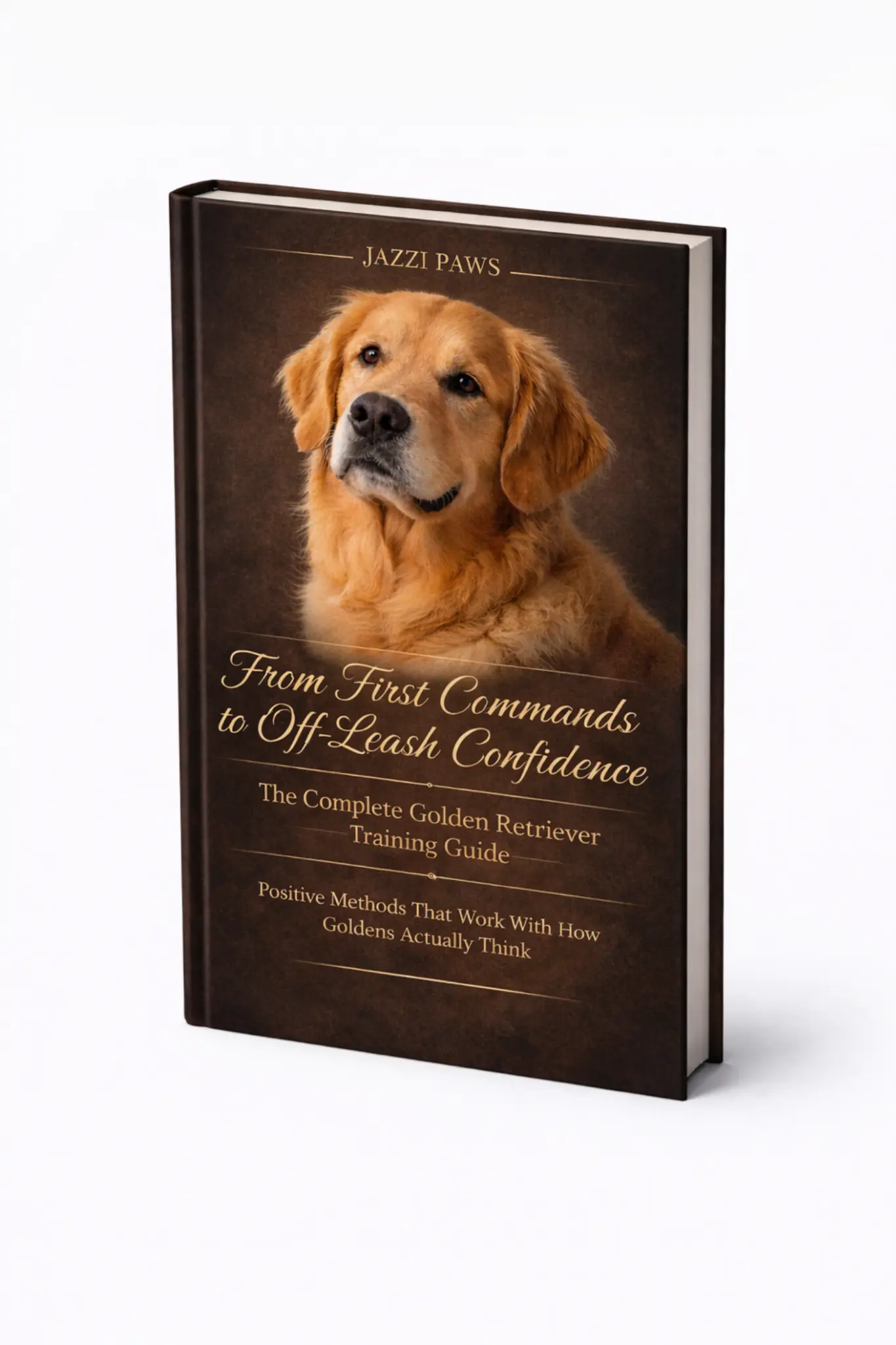
From First Commands to Off-Leash Confidence
The Complete Golden Retriever Training Guide — 59 pages. No fluff. No filler. Just the system.
This is the training program that takes your Golden from "ignores you at the park" to "turns on a dime when you call" — using methods backed by peer-reviewed research and adapted specifically for Golden Retriever psychology.
No punishment. No intimidation. No e-collars, prong collars, or devices designed to cause pain.
Just clear communication. Consistent practice. And a step-by-step system that works because it's built on how your dog actually learns.
What's Inside
10 Chapters. Every Problem Solved.
The Foundation (Pages 1–8)
The emotional truth about why you're struggling — and why it's not your fault. The Owner's Pledge: a printable commitment page you sign and post. Exactly how to use this guide based on your situation.
Chapter 1: How Golden Retrievers Actually Learn (Page 9)
The brain science in plain English — dopamine, neural pathways, why consistency matters more than intensity. Why harsh corrections backfire specifically with Goldens. The marker system that lets you communicate with precision timing.
Chapter 2: The Puppy Window (Page 13)
The 8-week socialization window most owners waste — and how to use every day of it. The complete socialization protocol: people, surfaces, sounds, handling, environments. Bite inhibition, house training, crate training.
Chapter 3: The Foundation Commands (Page 19)
Sit, Stay, Down, Leave It — taught correctly from the start. The lure method that works with Golden temperaments. Why 'sit, sit, SIT' teaches your dog to ignore you. The release word most owners forget.
Chapter 4: Leash Manners (Page 23)
Why your Golden pulls (hint: it's not dominance). The three methods that actually work: Stop-and-Go, Direction Change, Front-Clip Harness. The Decompression Walk — the most underrated tool in dog training, explained in full.
Chapter 5: Recall (Page 26)
The one command that can save your dog's life. Why recall fails — you're accidentally training them NOT to come. The four stages from indoor beginner to off-leash reliability. The five common mistakes that poison your recall cue. The emergency recall.
Chapter 6: Separation Anxiety (Page 29)
True separation anxiety vs. boredom — the diagnosis that changes everything. The graduated desensitization protocol for mild to moderate cases. Critical warning signs that mean you need professional help immediately.
Chapter 7: Reactivity and Overstimulation (Page 33)
Understanding threshold — and why training above it accomplishes nothing. Counter-conditioning and desensitization: the only protocol that works. The emergency exit: what to do when you're surprised by a trigger at close range.
Chapter 8: Off-Leash Confidence (Page 36)
The three Ds of proofing: Duration, Distance, Distraction. Why you must train each D separately before combining. Realistic timelines: what to expect at 6, 12, and 18 months. When NOT to go off-leash, even with solid training.
Chapter 9 & 10: Toolkit + Troubleshooting (Pages 38–44)
Equipment that works vs. equipment to avoid. The Treat Hierarchy. The 5-Minute Rule. The 10 most common Golden training problems with solutions. The Three Questions to ask when training stalls. The 80% Rule.
The Printable Training Tools
This Isn't Just Information. These Are Tools You Use.
Every tool in this guide is designed to be printed, posted, and used daily — not read once and forgotten.
Socialization Checklist (Pages 48–51)
70+ checkboxes across six categories: People, Surfaces, Sounds, Handling, Environments, Animals. Complete before 16 weeks. This checklist alone could prevent a $5,000 behavior consultation later.
Daily Training Log (Page 52)
Track every session. Commands practiced. Attempts and successes. Distraction level. What went well. What to work on. Patterns emerge. Progress becomes visible.
Weekly Progress Tracker (Page 53)
Rate 16 skills from 1–5. See where you're strong. See where you need work. Plan next week's focus.
Command Mastery Checklist (Pages 54–55)
A command isn't trained until it works everywhere. This checklist tracks proofing progress for Sit, Stay, Come, and Loose Leash — from 'follows lure' to 'first-time response in high distraction.'
Recall Building Log (Page 56)
Track your recall sessions. Running total of successful recalls. The goal: 500+ before off-leash freedom. This log makes the invisible visible.
Your First Week Action Plan (Pages 57–58)
Day 1: Gather your tools. Day 2: Charge your marker. Day 3: Teach sit. Day 4: Add the cue. Day 5: Fade the lure. Day 6: New environment. Day 7: Introduce down. You don't have to figure out where to start. It's already figured out.
What Golden Owners Are Saying
"My Golden would sprint away every time I called her at the park. I'd tried everything. After working through the recall chapter — specifically the 'four stages' protocol — she turned and came back to me within two weeks. I actually cried."
Amanda T., Oregon
"I didn't realize I was accidentally training my dog to ignore me. The section on 'poisoned recall cues' explained exactly what I'd been doing wrong for two years. Fixed it in a week."
Marcus L., Georgia
"The decompression walk changed our daily routine completely. My Golden used to come home from walks still wound up. Now she's calm and settled within minutes. I had no idea sniffing was that mentally exhausting for them."
Rachel S., Minnesota
The Next Time Your Golden Runs Toward the Road — Will They Come Back?
That question has a different answer after you work through Chapter 5.
30-Day Satisfaction Guarantee
Use the guide. Print the tools. Start the First Week Action Plan.
If it's not what you expected, email [email protected] and get your money back.
You're not risking $37. You're risking 30 days of trying something that might work.
Further reading from the Jazzi Paws blog:
Frequently Asked Questions
You already know what happens if nothing changes.
More walks where your arm gets pulled out of its socket. More moments at the dog park where everyone else's dog comes when called and yours doesn't. More fear every time a door opens or a leash slips.
Or.
You learn how your Golden actually thinks. You build a communication system that works. You show up consistently, follow the method, and watch something shift. It's not magic. It's not talent. It's just the right system, followed correctly, over time.
Your Golden already wants to listen. Teach them how.
By purchasing, you agree to our Terms of Service and Refund & Return Policy. See also: Disclaimer & Digital Product License.
Jazzi Paws is not a certified professional dog trainer. This guide is educational, based on publicly available positive reinforcement research. Dogs with serious behavioral issues including aggression, severe anxiety, or safety concerns should be evaluated by a certified professional (CPDT-KA, CPDT-KSA) or veterinary behaviorist before beginning any training protocol.